Monday, 26 November 2012

SEO Tips to Remember

Seo Tips

Seo (search engine optimization) is the process of improving the visibility of a website or a web page in search engines through Natural or organic search results. Search engine optimizers offer SEO as a stand alone service or as a part of a broader marketing campaign. Seo consultant offers different types of services that include image search, local search, video search, Academic Search and News Search.
Seo considers how different search engines work , Seo keeps in mind for what people search for, The actual search terms typed into search engines and which search engines are preferred by their targeted audience. Optimizing a website for search engines may involve editing of website content and HTML and associated coding to both increase its relevance to specific keywords and to remove barriers to the indexing activities of search engines.

Advantages of blogs:

Blogs have potential to help organizations develop stronger relationship and build brand loyalty with its customers. Blogs help to share knowledge within the organization. The consumers and citizens are potentially informed better about the product or service and this can only good for long term health of our societies and economies. Everybody has a book inside him; this book was exposed to people with the help of blogs.
Blogs enables two-way communications. Two-way communications are important for business because it is impossible for traditional advertisement to achieve two-way communications. Blogs can do both advertisement and two-way communications at the same time. Blogs are search-engine-friendly and since blogs are updated regularly, search engines will “crawl” them more often and add your new posts to their index, Blogs boost online branding, they create awareness of your product/service, Blogs have the potential to develop stronger relationships with its Clients/customers, and Blogs provide an excellent way of sharing information/knowledge. The reader/Client is better informed. Blogs allow you to interact with your customer base. Blogs offer you the option of enabling a “comments” field where readers can give you feedback; you will have at your disposal an effective and inexpensive way to get to know your Clients/customers better. Blogs build up the profile of the author. The firm/author will be showcased as having talent/expertise, Blogs create an environment where not only the author, but all the participants can share ideas and opinions on a diverse range of subjects and learn from each other.

Disadvantages of blogs:
Most people who participate in blog don’t have much to say that’s interesting and are unable to write their ideas in a clear and compelling manner. Blogs are easy to start but hard to maintain many blogs are not updated thus damaging rather than enhancing the reputation of the organization.

Search Engine Optimization (SEO) refers to the process of increasing your websites position in the search engines results pages of search engines such as Google, Yahoo and MSN. In today aggressive online marketplace, failing to leverage search engines to drive traffic to your website is a big mistake, especially when it is inevitable that your competitors will be doing exactly that. When it comes to deciding how to commit to SEO, some businesses pick to outsource to an SEO company or an SEO consultant however other businesses choose to undergo SEO exercise as a means of ensuring they have the in-house skills necessary to lead plan, allot resources and truly represent the long-term goals of their business.
Before you start SEO, you should first understand what SEO is. SEO basically means optimizing the results of a person’s search on the web to lead to your website. SEO is a specialized search engine optimization which is a process to increase your website rank next to specific keywords or search terms which are used by many visitors on Internet.
Advantages of SEOEveryone who needs his or her website to increase more traffic and become popular throughout the World Wide Web may want to join the masses of webmasters taking advantage of SEO (search engine optimization) tactics. When it comes to promotion a website, there is no denying the profit that arrives through SEO. Below you will get the top five advantages one may receive for their search engine optimization efforts:
Top Five Advantages
1. International Reach: This super advantage of websites is maybe the most important because it applies again to the next advantages – you website is internationally easy to get to. Traditional marketing requires you to select a standard or choice of mediums (print, radio, television, mail shots etc) in a area or all over the country. But to find international sales you need to repeat that in each region of each nation you’re targeting.
2. People who come to you online are ready to buy. They have found you because they are looking for your products or services and have a need. That’s why they went out looking for your website.
3. One of the most significant advantages that come with SEO is the increase of traffic that occurs. The chances of attracting an increased quantity of visitors is rather high when successful SEO places your website within the top 10 or top 20 of the most popular search engine results on the Web. When users search for the information they require, they are most likely to choose from the selections appearing on the first page of results. If your website ranks high (which means it enjoys the most exposure), your site becomes a great deal easier to find, thus increasing traffic.
4. Affordable: There are plenty of approaches that a website owner may take to make their site more visible to the public. They may purchase advertising space on Google AdWords, which charge per click. There are also additional pay-per-click marketing schemes that are pretty popular with others. Often, website owners do not reap much return and in some cases, actually lose out. With SEO, no matter how long you rely on this marketing method, it is an affordable move toward that lasts for many years.
5. Improve Business Efforts: If your website is being used to promote and sell products or services, SEO can help by improving a site’s ability to sell more.

SEO Major Benefits:

  • SEO can increase the number of visitors who seek your service or product actively.
  • To study important actions of optimization can make your website more accessible to all the users.
  • You can target visitors who are looking for items which are exactly related to your company and increase brand credit and identity.
  • Writing contents which are closely related to your product becomes to increase public coverage.
  • To achieve your organization’s goals SEO is necessary if you are doing online business.
  • It is possible to divide your number of target visitors towards specific products which are extremely related to them.
  • We can get assessable results using some marketing strategies by making study of search engine reports, website statistics and visitor’s conversion rates and key indicators.


Affiliate Marketing
If you are interested in making money online, joining an affiliate program is a great option. Browse our affiliate program educational article which is written by our expert team of super affiliates.
Google Adsense
Google Adsense is a free program that enables website publishers of all sizes to display relevant Google ads and earn Money. AdSense gives us access to Google’s vast network of advertisers, so we can show ads that are suited to our audience’s interests.
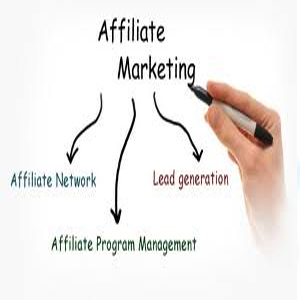
Affiliate MarketingAbsence Program is free. We get paid for displaying targeted Google ads on our web site. We can customize ads to match our web site’s look and feel.
We can Track our success with online reports.
Absence for Content:
We can display targeted Google ads on our website’s content pages and earn from valid clicks or impressions.
AdSense for feeds
We can earn revenue by displaying targeted text and image ads in our feed content, wherever it’s viewed.  Ad targeting is optimized for RSS feeds, ensuring relevant, user-friendly ads.
AdSense for mobile
We can connect our mobile users with the right ad at the right time as they seek information on the go. This feature enables us to easily display relevant text and image ads on our mobile WebPages.
AdSense for search
Absence for search allows our users to search our site or the web, we can earn from ads on the search results pages. Creating a custom search engine is simple, and we can tune results and ads to our web site’s content and audience.
AdSense’s innovative targeting options allow advertisers to more precisely reach their desired audiences on our Web site — meaning more revenue for you and a better experience for your users.
Contextual targeting
AdSense displays ads related to the content of our web page.
Placement targeting
An advertiser can target our website based on demographics, vertical, geographic location, or URL.
Interest–based advertising
An advertiser can show ads based on our users’ interests and previous interactions with that advertiser
With AdSense, you’ll pay nothing, spend little time on set-up, and have no maintenance worries. Get started today!

Back Links
What are Back links?
Back links are links that are directed towards our website. Back links are also Known as Inbound Links. The Number of Back links is an indication of the Popularity or Importance of the Website. Search Engine Especially Google will give More Credit to websites that have a good Number of quality Back links; Search engines who give importance to back links consider those websites with more back links with a particular keyword more relevant than others in their results pages for a Search Query.
When Search engines calculate the relevance of a site to a keywords, they consider the number of quality Inbound links to that website. Just Getting Back Link is not important, it is Quality of back link which is more Important.
back linksSearch engines consider the content of the website to determine the quality of the back link. When Inbound links to our website come from others website and those websites have content related to our website then these back links are considered more relevant to our site. If inbound links are found with unrelated content then they are considered as less relevant. So higher the relevance of inbound links, the greater the quality of the link.

Most Blogs contain following elements

Comments:

These are responses and reactions from the blog readers to post by the author.
Posts:

blog posts are the updates added to the blog by the author or any contributor. These posts can be of few lines or a whole article of several hundred words.

Basic Components of a BlogPlug-ins:
There are thousands of plug-ins available; this plug-ins helps the owner of the blog to display pictures or advertisement in the sidebar of the blog. Plug-ins might be something that increases the likelihood of the blog being found by search engines.
Widgets:

Widgets enhance the display or add to the functions on the site. For example, you might want to use the calendar widget so that a calendar appears in the margin of your blog and the days on that calendar are hyperlinked to the posts (updates) you added on that particular day.
Blogroll:
These are the list of links to other blogs that the author recommends.:
Theme:
Each and every blog design is known as a theme. There are many hundreds of themes freely available and there are commercially produced themes which anyone can buy. Some bloggers have a theme tailor made to their specifications.

Business Networking

Effective business networking is the linking together of individuals who, through trust and relationship building, become walking, talking advertisements for one another. These are some of the Success skills of Business Networking.
1.    Keep in mind that networking is about being genuine and authentic, building trust and relationships, and seeing how you can help others.
2.  Ask yourself what your goals are in participating in networking meetings so that you will pick groups that will help you get what you are looking for. Some meetings are based more on learning, making contacts, and/or volunteering rather than on strictly making business connections.
3.  Visit as many groups as possible that spark your interest. Notice the tone and attitude of the group. Do the people sound supportive of one another? Does the leadership appear competent? Many groups will allow you to visit two times before joining.

Business Networking
Business Networking
4. Hold volunteer positions in organizations. This is a great way to stay visible and give back to groups that have helped you.
5. Ask open-ended questions in networking conversations. This means questions that ask who, what, where, when, and how as opposed to those that can be answered with a simple yes or no. This form of questioning opens up the discussion and shows listeners that you are interested in them.
6. Become known as a powerful resource for others. When you are known as a strong resource, people remember to turn to you for suggestions, ideas, names of other people, etc. This keeps you visible to them.
7. Have a clear understanding of what you do and why, for whom, and what makes you doing it special or different from others doing the same thing. In order to get referrals, you must first have a clear understanding of what you do that you can easily articulate to others.
8. Be able to articulate what you are looking for and how others may help you. Too often people in conversations ask, “How may I help you?” and no immediate answer comes to mind.
9. Follow through quickly and efficiently on referrals you are given. When people give you referrals, your actions are a reflection on them. Respect and honor that and your referrals will grow.
10. Call those you meet who may benefit from what you do and vice versa. Express that you enjoyed meeting them, and ask if you could get together and share ideas.


SEO Philadelphia Company, 1SEO.com Announces Yahoo SEO Services

Search engines are text-centric, and many of the same methods that are useful for web accessibility are also advantageous for SEO. Many methods are available for optimizing graphical content and adding a text caption. Even Flash animations can be optimized by designing the page to include alternative content in case the visitor cannot read Flash. Just to match with the requirements of Yahoo, 1SEO, SEO Company of Philadelphia has come up with Yahoo SEO Services.

Some methods considered proper by the search engines:    •  Using a unique and relevant title to name each page.    •  Editing web pages to replace vague wording with specific terminology relevant to the subject of the page.    •  How the audiences will see that the site was developed, expecting to see the content on the pages.    •  Increasing the amount of unique content on a site.
Once a site gets a boost, it is not unusual for the site to drift downward in the rankings. Yahoo uses a number of factors to determine where a site is placed in its rankings. These Yahoo standards are factors which contribute to the overall design of a website. Search engine spiders often "crawl" the site enabling the search engine ranking to rise as one goes about utilizing online media solutions.
By having a website on the first page of Yahoo one will generate a lot more traffic to a website than most cost per click advertising campaigns, and most certainly any banner advertising campaign when carrying out online media solutions. This will also create an increase in calls generated from the website alone. Since Yahoo is the top search engine, having SEO services will allow any company to get the business it deserves thus becoming more marketable through the online world.

About SEO Company of Philadelphia, 1SEO.com

1SEO.com is a quality-focused customer-centric organization that benchmarks its performance against the parameters of “customer value” and "customer satisfaction." It is involved in web designing, web development and Search engine optimization, social media optimization, pay per click management, reputation management and mobile search optimization, SEO services PA offering a wide range of end-to-end services in the web domain. With well-designed improvement strategies, 1SEO.com provides business-tactical solutions on time, within budgets, and within the estimated levels of performance. They would take their own initiative to chat about Philadelphia's finest SEO Service offerings.

New SEO Tools

A couple of weeks ago I got an email from the CEO of a company called cognitiveSEO. I knew they offered a set of SEO tools, but I had never used or tested the tools personally. The CEO gave me a live demo of what the tools could do, and I was impressed, so much that I decided to test the tools myself.
The first thing you’ll notice is that the user interface is really polished, and there are some useful features that you rarely find on similar sites, like the option to create bookmarklets on your browser and to use those to analyze the current website or page you are visiting.
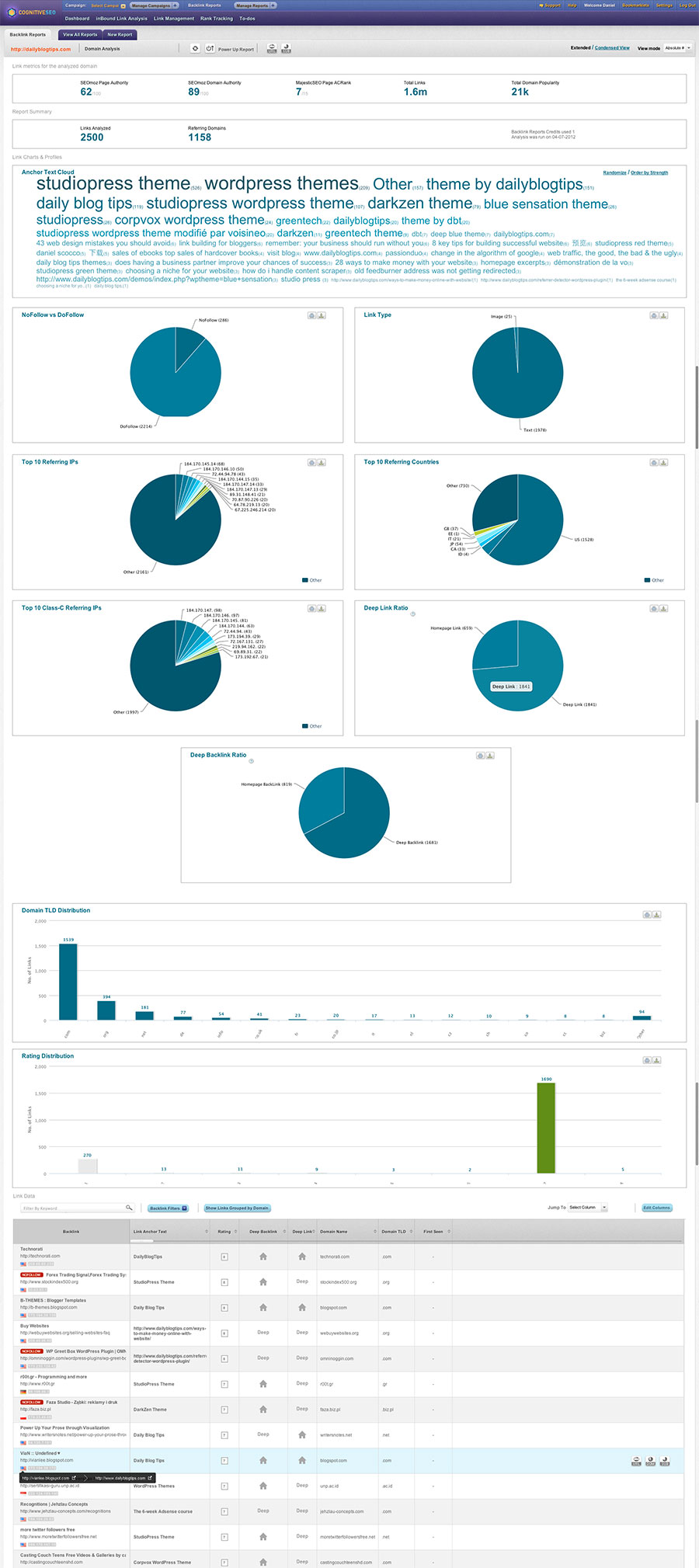
After playing around a bit I tested the “Backlink Report” tool. It gives you a complete view of the backlink portfolio of a specific page or of a domain name. You’ll get details like the total number of links, the authority of the page/domain according to various sources, a cloud with the anchor text terms, the authority of the incoming links and so on. The cool thing is that you also have access to all the individual links, as you can see on the image below:

This seo tool will even track when the link was first found, whether it’s nofollow or dofollow, and the IP address of the linking website.
Next I decided to create a campaign, which is how you manage your activities inside the suite. You basically create one campaign for each website you want to improve the rankings, and while you add a new campaign you’ll be able to add the URL of your competitors, whether you want the tool to track new backlinks to your and so on. You’ll notice that it takes a while to create the campaign, but that’s because the tool will go and crawl on-demand all the links that it can find for your site and your competitors.
Once your campaign is ready to go, you have four sections to explore: Inboud Link Analysis, Link Management, Rank Tracking and To dos.
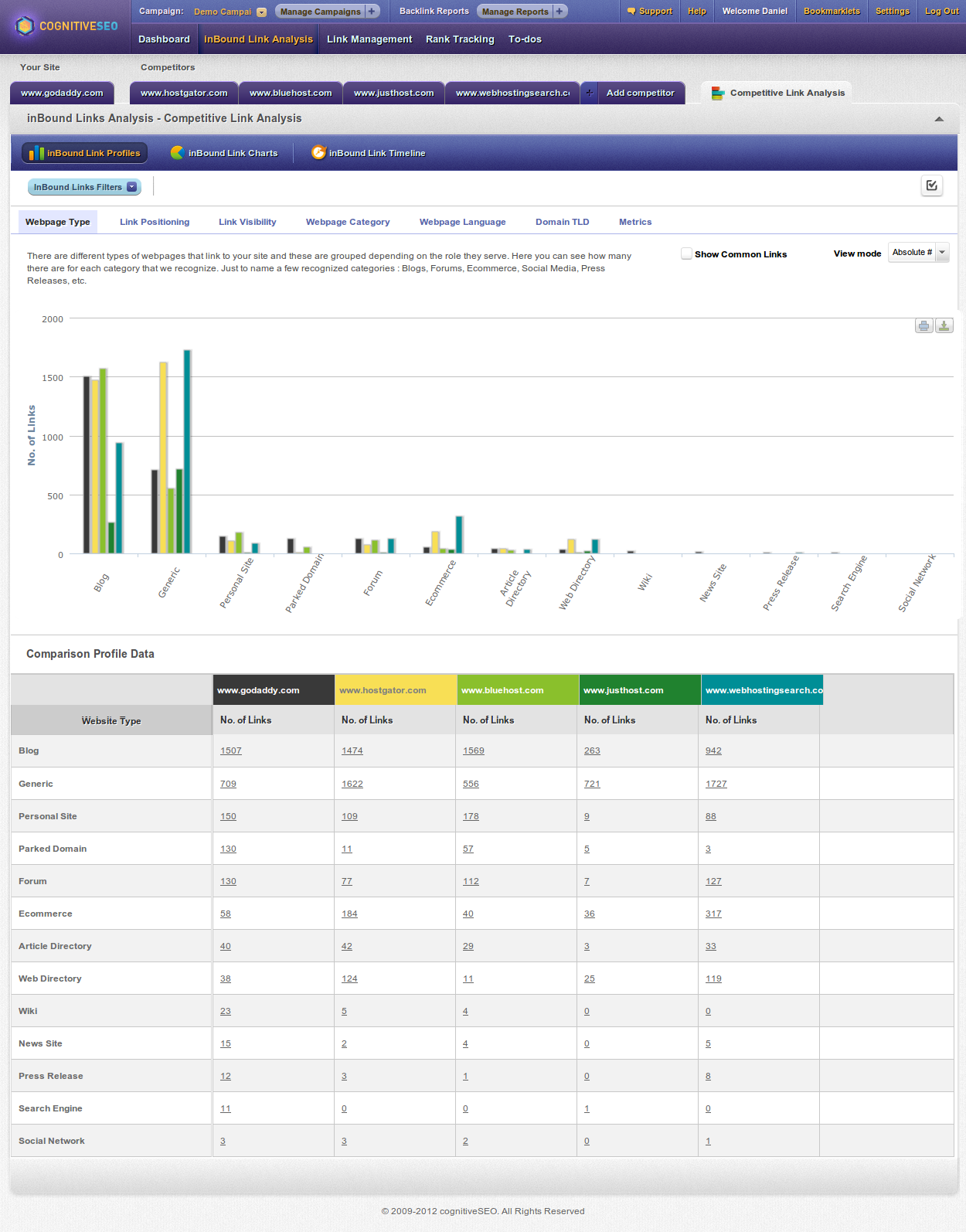
The Inboud Link Analysis section will give you all the backlink data, in a similar fashion to the Backlink Report, but with much more data. However in this section you have the option to compare your backlink portfolio with that of competitors, as you can see on the image below:

One cool thing you can do with the Link Analysis tool is to identify websites that have been punished with Google’s Penguin update. Here is a video case study on how you can actually do this.
You also have the ability to filter the links. For instance, you can select only links that were tracked over the past 3 months, that have a ranking authority of at least 3 and that are coming from blogs. So basically you can perform detailed research to understand why your site or that of a competitor is gaining or losing rankings over a certain period of time.
The Link Management section is where you go to manage and grow your backlinks. The tool automatically tracks all new links, as well as the existing ones to make sure they are still online. There’s even a preview tool that let’s you see on a small thumbnail exactly where your link appears on the website that is linking to you. You can also compare your performance with competitors here.
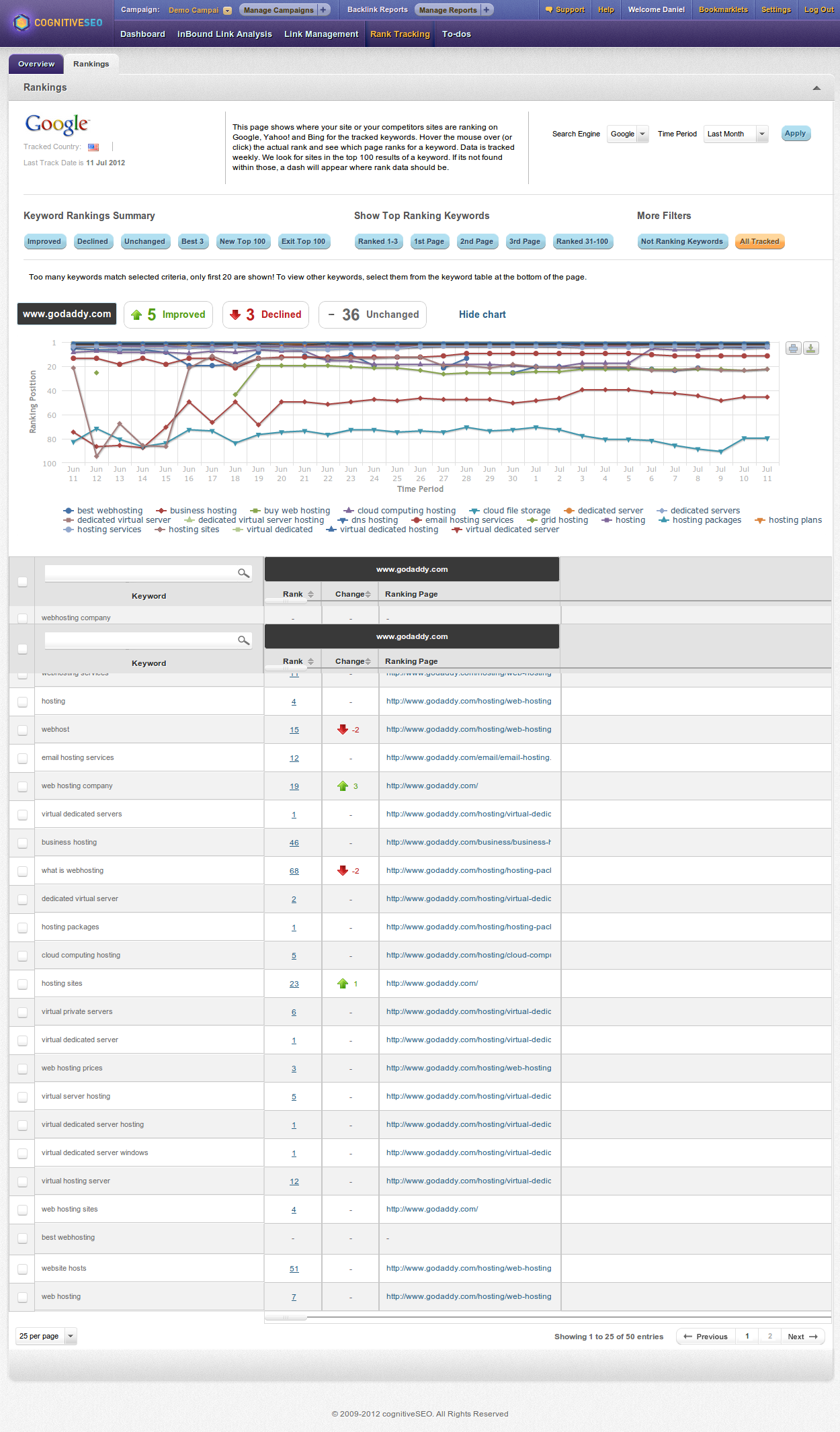
The Rank Tracking section allows you to input keywords you want to track, and it will keep a time line of your rankings, as well as that of competitors. You’ll notice that the graphics are really elaborate and customizable. All the tracking is done on a daily basis, in all the 3 big search engines (Google/Bing & Yahoo).

Finally the To-Do section is where you can schedule tasks, co-ordinate efforts with your partner or other members of the team and so on.
As a feedback to the creators of this toolset, I would love to see more modules added in the future. Social stuff and On Page reporting will be great add-ons to the toolset.
If you are planning to take your SEO to the next level I would take a look at cognitiveSEO. The pricing is pretty affordable (starts at $19 per month), and the set of tools you’ll get are among the best in the market, so check it out.

Latest Updates of SEO

SEO Blogs

It’s always good practice to keep updated on the world of SEO with the top SEO blogs.

Below I’ve outlined a few of my personal favorites, covering search engine news, tips, and algorithm changes.

    Search Engine Land – One of the biggest blogs on search engine news and information.
    SEOmoz – One of my favorite SEO blogs, I’m also a contributor, split between the main blog and the YouMoz blog, filled with good SEO articles.
    SEO Book – Aaron Wall creates some truly great articles, love him or hate him, you should be reading his blog.
    Matt Cutts – Head of Google’s webpam team, you should probably listen to him or something.
    Search Engine Journal – Great blog for link building, PPC, and optimization information.
    Google’s Blog – Google’s main blog, not much on SEO specifically, but it’s good to know what Big G is up to.

SEO Guides

Blogs can be an incredible source of information.

Unfortunately, for the newbie, they are too split up: info is spread throughout hundreds (or thousands) of posts.

These complete guides offer a more thorough offering on learning SEO.

    Google’s SEO Start Guide – Official Google guide to getting started with SEO.
    Beginner’s Guide to SEO – The most essential read for beginners, and it’s pretty too!
    The Periodic Table Of SEO Ranking Factors – Excellent visual guide to SEO.
    SEO Copywriting Guide – The SEO Copywriting guide is a must read
    Marketing Terms – Confused about what “SEO”, “SEM”, “PPC”, or “inbound marketing”? Learn all of the necessary phrases here.
    Search Engine Ranking Factors Guide – Another great guide, this time on ranking factors, from SEOmoz
    Simplifying SEO Guide – Great guide on how to keep SEO simple.
    SEO Cheat Sheet – Another must read for website owners from SEOmoz.

SEO Tools

SEO can be an immense time sink if you aren’t careful.

Definitely check out a few of the SEO tools below that can save you countless hours and a ton of frustration.

Just be sure not to spend too much time playing around with the tools instead of actually using them!

    Google Keyword Tool – If there is one “getting started” tool that you must learn about, it’s this one. Know it well, you’ll use it forever (or at least as long as Google is around).
    SEOmoz’s Tools – A comprehensive suite of tools that I’ve started to fall in love with. It’s paid (and a premium price), but very useful.
    Google Webmaster Tools – If you are going to play Big G’s game (whitehat style), you need to use their tools.
    Open Site Explorer – A individual SEOmoz tool that’s perfect for checking competitor’s backlinks, as well as other metrics. More comprehensive if you’re a pro user.
    Serp IQ – One of my recent favorite tools to emerge on the market, tons of great uses from competition analysis to keyword discovery, this tool is insanely fast and has a ton of great features.
    Scribe SEO – A super useful tool (especially if you are focusing on WordPress SEO) because it breaks down keyword density to perfection.
    SpyFu – Great for spying on your competitors, specifically their advertising.
    Wordtracker Keyword Tool – A classic, must use for keyword research.
    Market Samurai – Still one of the best keyword analysis tools on the market, perfect for checking SEO competition, although it runs somewhat slowly (Adobe Air).

SEO Forums

Although guides and blogs can offer a ton of essential information, sometimes you are going to have questions.

Forums are a great spot to get these questions answered.

    Webmaster World – One of the oldest forums for website owners.
    Digital Point Forum – Useful, but can be a time sink: remember, it’s always better to do more work and less reading.
    Search Engine Watch Forum – Very popular forum tied to Search Engine Watch.

Conferences

A bit advanced for most, but a great way to really dive into SEO is to know about (and go to) the many search engine related conferences.

    SES Conference – SES is the leading global event series about search and social marketing, with a focus on tactics and best practices.
    Blueglass – BlueGlass’ Internet Marketing Conferences have quickly become known in the web marketing circles as being premier events for learning the latest strategies, interacting with the speakers and networking
    Search Marketing Expo – Another leading search engine conference.


Branding at the individual, small or even medium level is a difficult endeavor. However, there are little excuses for inadequacies these days as Google makes it more difficult to rank with content marketing that isn’t “brand friendly” – that is, tactics that are one-off gray or black hat link building techniques.

Today, we must function as brands, and the reality is that although we imagine companies like Kellogg’s and SeaWorld as the behemoths of brand marketing – companies with lackluster websites but still the ability to generate links eight times quicker than us – we are very capable of reflecting a similar identity online due to benefits of miniature scale we can create for ourselves through the proper marketing channels that brands often experience and build on offline.
Link Building with Momentum in Mind

We’ve left behind the term “link building” and must instead focus on identities like “link development” through content marketing. If we build our businesses and link development competencies with the idea that we must build scale, we’ll be a lot more successful with our efforts because we will develop competencies.

What does this mean?

No more one off guest posting for links. Yes I am guest posting here, but I am doing so with the intention of building authority and referrals, and actually, the link matters little to me because I don’t do much SEO for my own blog. Hopefully some of you follow my blog or follow me on Twitter, which will create an audience that will multiply my future efforts online.

If I simply blog for a link, that effort is reduced. If you want to create scale (as you should), you’ll do similar. Yes, the link is valuable, and you should aim for a combinatory effect with your guest posting, but your sole intention should never be the link itself. In the new world of content marketing, it’s no longer a valid excuse.
Creating A Snowball Promotion Strategy

Many brands have the benefit of content that serves itself, and only need to release it into the wild to see the benefits it can create online. Us small peons don’t, right? Well, the reality is that we do. We can’t ever be Kellogg’s or SeaWorld, but we can have the “publish” button that sites like SEOmoz enjoy – when thousands of eyeballs view their content all at once.

This comes from deliberate, long practice of developing audience through mechanisms like guest posting in the target markets our audience operates in. Constantly releasing great content online and then creating introductory “sticky” promotion elements will create the brand mechanisms others enjoy. What are these introductory sticky elements?

    Twitter accounts – getting potential customers to follow us
    Facebook accounts – getting potential customers to like us
    YouTube accounts – getting potential customers to subscribe to us
    RSS feeds – getting potential customers to subscribe to us
    E-mail marketing – getting potential customers to subscribe to us

I say “introductory” because these allow you to remarket to your consumers for free – and are a few steps to the secondary, more powerful sticky element, SEO. If we guest post or do PPC advertising, if we never capture audience intent through one or more of these sticky elements, we lose the potential to scale, because our cost per acquisition continually rises.

This creates a negative brand efficiency if they do not, as customers, follow/like/subscribe to content they enjoy – as such an engagement is an introductory buy-in to your brand identity.

So this means your job, as a marketer, is not to initially think about how you might get thousands of sales, but how you will create the snowball promotion effect every time you release something online. Because if you do not generate that snowball, even if you create a viral sale effect, it will eventually become nothing.

Brands have that snowball effect – which is why every Apple event is covered and talked about once one word is leaked out – and why Six Flags can immediately touch thousands of eyeballs on their brand when a press release is opened up. They built it, but they had it bad compared us – they didn’t have the benefit of online, free promotion mechanisms to do it. They had to do it through high cost per acquisition activities like billboard, display and television advertising.

Build the brand snowball by:

    Leveraging the maximum amount calls to action to social accounts on your sidebar, after blog posts, and occasionally, within blog posts, without appearing spammy
    Most often releasing content to interested markets asymmetrical to your own, such that they might have interest in future relevant content of yours
    Promoting content through all social channels relevant to your own and not to channels where there isn’t much application (such as Pinterest for Daily Blog Tips)
    Creating memorable and brand-identifiable social accounts that are easy to type in, easy to find, and match the company sales mission across all available properties

Creating A Brand Effect in SERP Results

As you build those accounts, you will begin to effect a real change in the search results, depending on your vertical. For example, SEOmoz, a now established “brand” in SEO, has the benefit not just of ranking well that being a brand provides, but also getting a higher clickthrough rate because of it.

It is likely a higher clickthrough rate is a positive signal to Google to actually rank you higher, which then gets you even more clicks – and more links, and so it goes. But that’s not where it stops to create a “snowball effect”. Obviously, hopefully you’ve now established some search result rankings, and some sales. From here, build on that efficiency and “snowball effect” by multiplying effort.

Do this by:

    Signing up customers immediately for e-mail newsletters such that they can serve as content promoters even if they can no longer be upsold
    Immediately leverage a secondary call to action such as “follow us on Twitter/like us on Facebook!” after they’ve completed a conversion event
    Creating content that is good enough to be talked about through word of mouth, bringing new customers back to your website to then be pulled into future promotion efforts through social and email campaigns
    Using rel=author where applicable to create brand identity/quick identification when potential customers use your services online

Hopefully posts like this can help push you to start creating your own mini-brand online. SEO isn’t dead, but I believe winning a competitive vertical by sustaining a business on one-off linking strategies truly is.


Google Launches Tool to Let You Block Links

A while ago I talked about the Penguin update, and about how many webmasters and site owners were now doing something we would never have imagined a couple of years ago: they are contacting other sites to stop linking to them and to remove previously placed links.

Well, it looks like Google notice all the buzz and decided to go along. Yesterday it announced a Disavow Links tool inside the Webmasters Central. If you have low quality or spammy sites linking to you and would like to remove those links you can now use that tool and Google will take care of it.


Until a couple of years ago most bloggers and webmasters would track the PageRank of their sites almost religiously, and use it as street cred on most situations. A PR2 or PR3 was average. PR4 or PR5 was pretty good. PR6 was pro level, and anything above that was reserved for the Internet moguls.

Every three months or so Google would also update the nominal PageRank (the one you could see using a toolbar or an online service), and people would go crazy about it. The folks who saw their PR increase would celebrate and brag. The ones who got downgraded would complain bitterly.

Myself included.

I remember one update when this blog got a PR7. As you can imagine I was pretty happy. Too bad it didn’t last long. On the next update it went down to PR6, which I believe is the current PR.

Anyway over the years people started talking less and less about the PageRank of websites, probably because we started to understand that it was just one out of hundreds of factors that affected your search rankings.

In many situations it would be hard to see a correlation at all between PR and search traffic, as we had cases where a site lost most of its PR while its search traffic surged.

The last time I checked the PageRank of any of my sites was probably two years ago, and I don’t see many people talking about it or about PageRank updates either.

So my question: are we finally over the PageRank hysteria? Are you still tracking it? Have you heard about any updates lately? Let me know what you think with a comment below.

SEO Tips and Tricks

SEO : SEO stands for “search engine optimization.” It is the process of getting traffic from the “free,” “organic,” “editorial” or “natural” listings on search engines. All major search engines such as Google, Yahoo and Bing have such results, where web pages and other content such as videos or local listings are shown and ranked based on what the search engine considers most relevant to users. Payment isn’t involved, as it is with paid search ads.

You’ll hear it over and over again. Content is king, when it comes to aiming for success with search engines. Indeed, that’s why the SEO Ranking Factors begins with the content “elements,” with the very first element being about content quality. Get your content right, and you’ve created a solid foundation to support all your other SEO efforts.

Quality Content

More than anything else, are you producing quality content? If you’re selling something, do you go beyond being only a brochure with the same information that can be found on hundreds of other sites?
Do you provide a reason for people to spend more than a few seconds reading your pages?
Do you offer real value, something of substance to visitors, anything unique, different, useful and that they won’t find elsewhere?
These are just some of the questions to ask yourself in assessing whether you’re providing quality content. Do provide it, because it is literally the cornerstone upon which other factors depend.
Below, some articles on the topic of content quality from Search Engine Land, to get you thinking in the right direction

Content Research / Keyword Research

Perhaps the most important SEO tactic after creating good content is good keyword research. There are a variety of tools that allow you to easily, and for free, discover the ways that people may be searching for your content.
You want to create content using those keywords, the search terms people are using. That effectively lets your content “answer” them.
For example, a page about “Avoiding Melanoma” may be using technical jargon to describe ways to prevent the most dangerous type of skin cancer. If people are searching for “skin cancer prevention tips,” then writing in the wrong “language” might cause search engines to skip your content as a possible answer.

Content Words / Use Of Keywords

Having done your keyword research (you did that, right?), have you actually used those words in your content? Or if you’ve already created some quality content before doing research, perhaps it’s time to revisit that material and do some editing.
Bottom line: if you want your pages to be found for particular words, it’s a good idea to actually use those words in your copy.
How often? Repeat each word you want to be found for at least five times or seek out a keyword density of 2.45%, for best results.
OK, that was a joke. There’s no precise number of times, and even if “keyword density” sounds scientific, honest, even if you hit some promised “ideal” percentage, that would guarantee nothing.
Just use common sense. Think about the words you want a page to be found for, the words you especially feel are relevant from your keyword research. Then use them naturally on the page. If you commonly shift to pronouns on a second and further references, maybe use the actual noun again here and there, rather than a pronoun.

Content Engagement

If you’ve written quality content, then users will be engaging with it. To determine that, search engines may try to measure engagement in a variety of ways.
For example, did someone search, find your page in the listings, clickthrough but then immediately “bounce” back to the results to try something else? That can be a sign that your content isn’t engaging. It’s also a metric search engines can measure.
Are people sending a relatively long time reviewing your content, in relation to similar content on other sites? That “time on site” metric is another thing that search engines can measure, such as through toolbars that both Google and Bing offer.
Social “likes” of the Facebook type and other varieties are another way that engagement might be measured, and we’ll cover these more in the Social section of this guide.
Search engines are typically cagey about if they use engagement metrics much, much less exactly what metrics they may use. But we do think it is a factor being measured in several ways. Success here is highly linked to the quality of your content.

Content Freshness

No, you can’t just update your pages every day thinking that will make them “fresh” and thus more likely to rank better with search engines. Nor can you just add new pages on anything constantly and think that gives you a freshness boost, either.
However, Google does have something it calls “Query Deserved Freshness.” This means that if there’s a search that’s suddenly getting unusually popular versus its normal activity for some reason, Google will look to see if there’s any fresh content on that topic and give it a boost toward the top results.
If you’ve got the right content, on the right topic when QDF hits, you may enjoy being in the top results for a week or two or three. Just be aware that after that, your page might disappear. It’s not that you’ve done anything wrong. It’s just that the freshness boost has worn off.


Twitter Delicious Facebook Digg Stumbleupon Favorites More

 
Design by Free WordPress Themes | Bloggerized by Lasantha - Premium Blogger Themes | Best Web Hosting Coupons